Social Anxiety Disorder Treatment in Lahore: Symptoms, Causes & Evidence-Based Solutions
When fear of judgment turns everyday interactions into a source of dread — evidence-based CBT, exposure therapy, and DBT skills, confidentially, in Lahore.
Social gatherings, public speaking, or striking up a conversation with an acquaintance can trigger mild nerves for anyone. But when the fear of being judged, scrutinized, or embarrassed turns everyday interactions into sources of intense dread, it extends beyond everyday shyness — and Social Anxiety Disorder (SAD), or social phobia, is a recognized, highly treatable condition.
Social Anxiety Disorder is a persistent, intense fear of being watched, judged, or embarrassed in social situations — different from everyday shyness because it disrupts relationships, academics, and career for 6 months or longer. It’s highly treatable through Cognitive Behavioral Therapy, systematic exposure therapy, and DBT-based mindfulness skills, available confidentially in Lahore.
What Is Social Anxiety Disorder?
Social Anxiety Disorder is characterized by a persistent, intense fear of social or performance situations where one might be watched, evaluated, or judged by others. Unlike general introversion — where someone simply prefers quieter environments — people with social anxiety deeply fear negative evaluation, rejection, or appearing visibly anxious, such as blushing, trembling, or stumbling over words.
Shyness is a personality trait that doesn’t stop you from participating. Social Anxiety Disorder is a clinical condition involving intense fear of judgment that actively limits daily life for 6 months or longer.
Common Triggers
- ✓Speaking or presenting in front of a group
- ✓Attending parties, social gatherings, or networking events
- ✓Meeting new people or authority figures
- ✓Eating, drinking, or writing in public
- ✓Making phone calls or initiating small talk
The Cycle of Social Anxiety
Social anxiety operates as a self-reinforcing loop that keeps individuals feeling stuck:
Anticipatory Anxiety
Days or hours before an event, the mind visualizes worst-case scenarios and catastrophic failures.
Physiological Arousal
During the event, the body’s sympathetic nervous system triggers the “fight-or-flight” response — elevated heart rate, sweating, shaky voice, or muscle tension.
Self-Focused Attention
Rather than focusing on the conversation or surroundings, attention shifts entirely inward to physical sensations — “Everyone can see my hands shaking.”
Post-Event Processing (“Ruminating”)
After the interaction, the individual replays every moment in their head, over-analyzing minor details and reinforcing the belief that the interaction was a failure.
Shyness vs. Social Anxiety Disorder
| Aspect | Everyday Shyness | Social Anxiety Disorder |
|---|---|---|
| Impact on Life | Mild discomfort; doesn’t disrupt daily goals | Causes significant distress; limits career or academic potential |
| Avoidance Behavior | Pushes through discomfort to participate | Actively avoids social situations or endures them with intense dread |
| Physical Symptoms | Minor nervous energy | Severe physical symptoms (racing heart, nausea, panic) |
| Duration | Temporary; fades as you get comfortable | Persistent; often lasts 6 months or longer without treatment |
Evidence-Based Approaches to Managing Social Anxiety
Social anxiety is highly treatable. Clinical psychology offers several structured, research-backed modalities to break the anxiety cycle:
- ✓Cognitive Behavioral Therapy (CBT) & Cognitive Restructuring — identifies cognitive distortions like Mind Reading (“They think I look foolish”) or Catastrophizing (“If I mess up, my career is over”) and reframes them into realistic, balanced perspectives.
- ✓Systematic Exposure Therapy — gradual, controlled exposure to feared social situations (asking a stranger for directions, then making small talk with a cashier) teaches the nervous system that these situations are safe.
- ✓Mindfulness & DBT Skills — grounding techniques such as paced breathing and sensory orientation shift focus outward and bring the prefrontal cortex back online during moments of high stress.
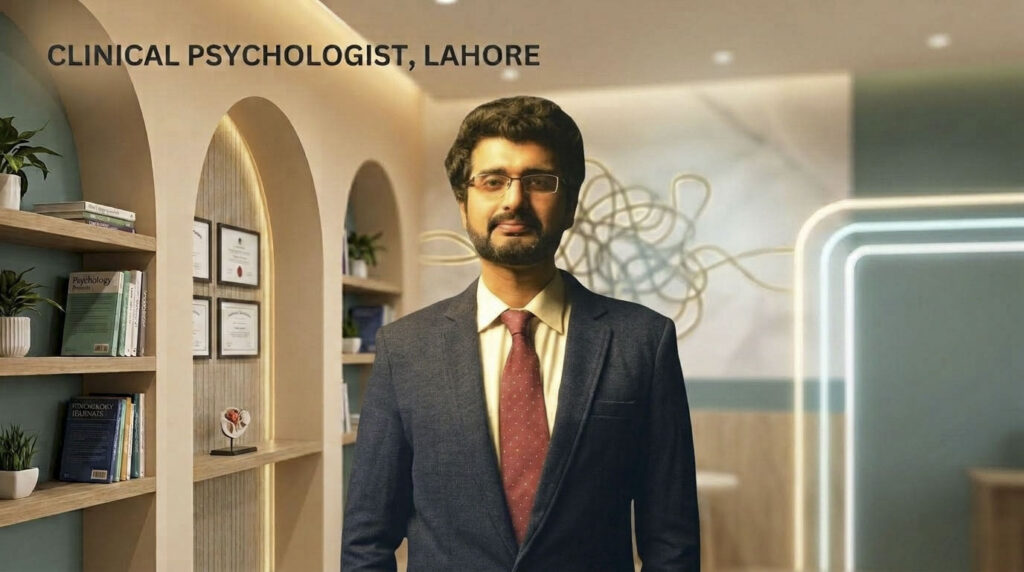
My aim is independence, not dependence. I want to train you to handle life’s long-run challenges on your own, without the fear that your mental health problems will disturb you again.— Ahmad Ali Chughtai, Clinical Psychologist
Ready to Talk to Someone?
Sessions are confidential — whatever the situation that feels hardest to face right now.
Book a Confidential ConsultationFrequently Asked Questions
Q: What is Social Anxiety Disorder (SAD)?
A: A persistent, intense fear of social or performance situations where you might be watched, evaluated, or judged, distinct from everyday shyness.
Q: How is social anxiety different from shyness?
A: — Shyness is mild and temporary; SAD causes significant distress, active avoidance, and severe physical symptoms that persist for 6 months or longer.
Q: How is social anxiety disorder treated in Lahore?
A: Through evidence-based Cognitive Behavioral Therapy, systematic exposure therapy, and DBT-based mindfulness skills, tailored to the specific triggers involved.
Q: What is exposure therapy for social anxiety?
A: Gradual, controlled exposure to feared social situations, starting small and building up, so the nervous system learns these situations are safe.
Q: Can DBT help with social anxiety?
A: Yes — DBT grounding and mindfulness techniques help shift focus outward and calm the body’s stress response during high-anxiety moments.
Q: How long does it take to see improvement?
A: This varies by individual, but structured CBT and exposure work typically show measurable progress within a course of regular sessions.